What Does a Construction Foreman Do? Duties, Pay and How to Become One
A construction foreman runs one crew: who does what today, safely and to the drawings. What the job involves, what it pays and how tradespeople get there.
Construction foreman: the short answer
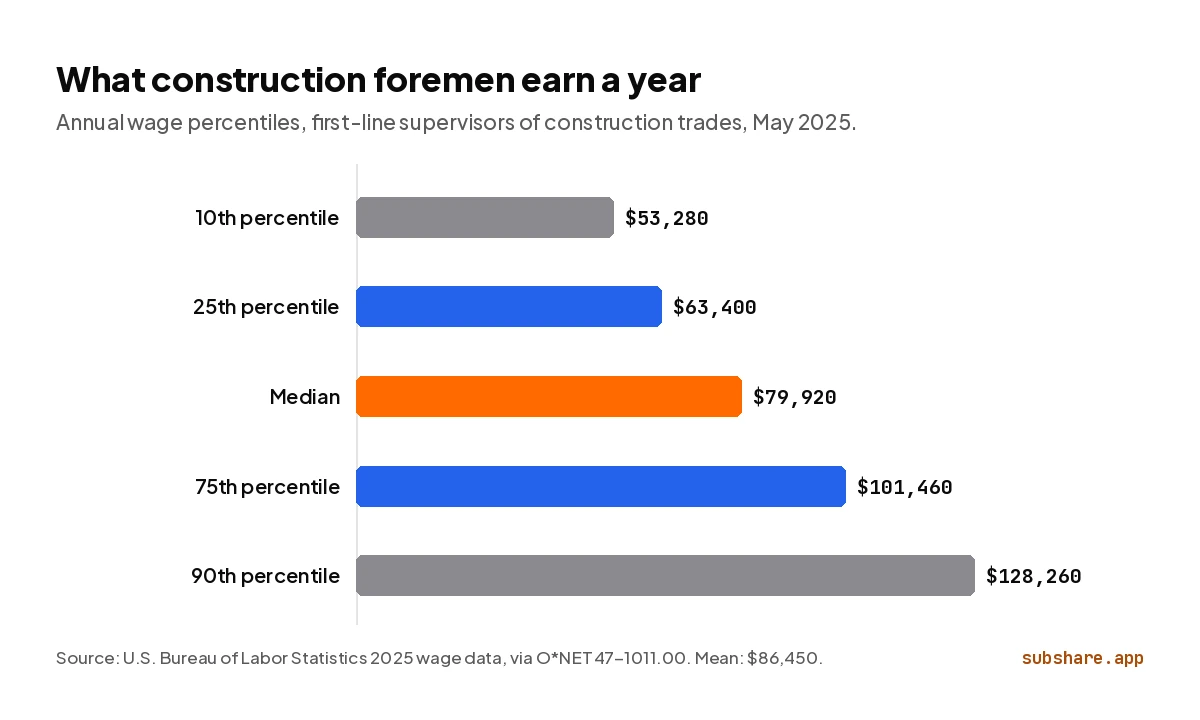
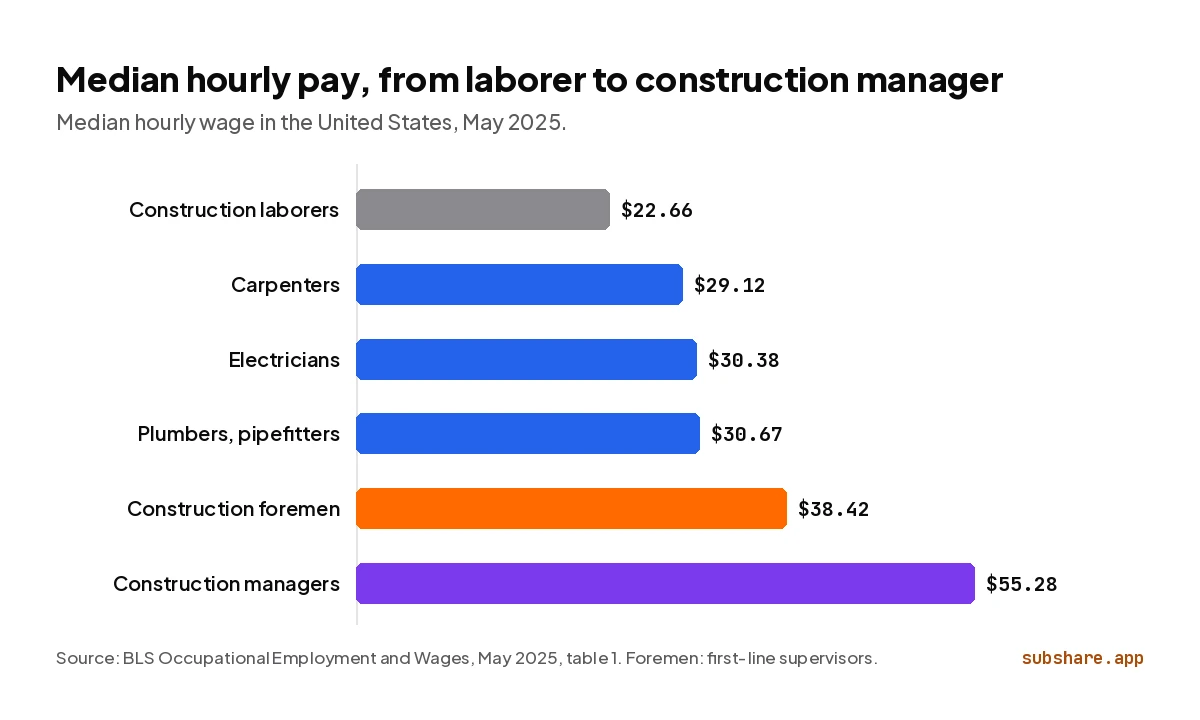
A construction foreman is the working leader of one crew or trade on a construction site. The foreman decides who does which task each day, makes sure the work matches the drawings, keeps the crew safe, orders materials and reports progress to the superintendent. The Bureau of Labor Statistics counts foremen among first-line supervisors of construction trades and extraction workers: 812,210 jobs in May 2025, with a median wage of $38.42 an hour, or $79,920 a year. The top 10% earned more than $128,260. That median is 32% above a carpenter's and 26% above an electrician's. Most foremen get there by learning a trade, working as a journeyworker and then a lead hand; no degree is needed.
On most jobs, the foreman is the person the crew actually answers to. The project manager signs the contract and the superintendent runs the site, but the foreman is the one who says at 6:30 in the morning that you are on the third floor today, here is the drawing, and the inspector comes at two.
This guide covers what the job involves, how it differs from the superintendent and general foreman, what it pays, and how people get there. Pay and employment come from the Bureau of Labor Statistics May 2025 survey, released May 15, 2026, and the duties from O*NET, the Department of Labor's occupation database, checked on November 17, 2026. Disclosure: we make SubShare, a crew scheduling tool foremen use. It appears in one labeled section near the end.
What is a construction foreman?
A construction foreman is a first-line supervisor who leads one crew, usually of a single trade, on a construction site. Framers, electricians, concrete finishers and drywall hangers each have their own. The foreman reports to the superintendent or to their own company's project manager, and the crew reports to the foreman.
The title changes with the company and the trade: crew lead, crew chief, working foreman, field supervisor. O*NET's sample titles for the occupation include construction foreman, construction supervisor, electrical supervisor, sheet metal foreman and site superintendent. Official statistics put them all in one group, SOC code 47-1011, first-line supervisors of construction trades and extraction workers.
It is a big group. With 812,210 jobs in May 2025, it is the second-largest construction occupation in the BLS survey, behind construction laborers and ahead of electricians (757,220) and carpenters (670,090).
What does a construction foreman do?
A foreman's job comes down to 4 things: plan the crew's work, run it on site, keep it safe and to spec, and report what happened. O*NET's task list for the occupation, built from surveys of people in the job, reads like a foreman's week:
| Part of the job | Tasks from O*NET | What it looks like on site |
|---|---|---|
| Plan | Read specifications such as blueprints; estimate material or worker requirements; order materials | Tomorrow’s tasks, the people and the deliveries they need |
| Run | Supervise, coordinate or schedule workers; assign work based on the job’s requirements | Who goes where at 7:00, and the changes at 10:00 |
| Coordinate | Coordinate work with other project activities; confer with managers and contractors to resolve problems | Sorting out with the plumber who gets the ceiling first |
| Protect | Inspect work, equipment and sites for safety and to meet specifications; train workers in methods and safety | The morning safety talk, checking the scaffold, fixing work before the inspector sees it |
| Report | Record personnel, production or operational data; suggest promotions, transfers or hires | The daily report, hours, and who is ready for more |
Source: O*NET 47-1011.00, First-Line Supervisors of Construction Trades and Extraction Workers, task list (15 tasks, condensed). The last column is our summary.
The work context O*NET records explains why the job is harder than the list makes it sound. Of the foremen surveyed, 86% make decisions every day, 78% say they have very high responsibility for the health and safety of other workers, and 63% work more than 40 hours a week. 59% are outdoors in all weather every day.
What does a foreman's day look like?
No two days are the same, but most follow the same shape: plan early, walk the work, fix what changed, and set up tomorrow. Here is a typical day for a framing foreman with an 8-person crew on a commercial job.
| Time | What the foreman is doing |
|---|---|
| 6:00 | On site before the crew. Checks deliveries, the weather and who has called in sick, and adjusts the day’s plan. |
| 6:45 | Safety talk with the crew: today’s tasks, today’s hazards, who works where. |
| 7:00 | Work starts. Sends each pair to their area with the drawings they need. |
| 9:30 | Walks the floor. Checks layout against the drawings, answers questions, catches mistakes early. |
| 11:00 | Coordination with the superintendent and the other trade foremen: who needs which area next. |
| 13:00 | Moves two people to a wall the electrician needs closed by Thursday. Calls the supplier about short studs. |
| 15:00 | Inspection of the second-floor walls. Fixes the one note before the inspector leaves. |
| 15:30 | Writes the daily report: hours, work completed, delays, materials needed. |
| After work | Plans tomorrow: who goes where, what they need, and sends it to the crew. |
Our illustration of a common pattern, not survey data. Start times and the split between planning and tool work vary by trade, company and crew size.
The last row is the one that decides whether tomorrow starts well. A crew that finds out at 7:00 where it is working has already lost the first half hour.
Foreman vs general foreman vs superintendent vs project manager
A foreman runs one crew. A general foreman runs several foremen of the same trade. A superintendent runs the whole site, every trade included. A project manager runs the contract, the budget and the client from the office. Small companies merge these roles; large ones add more.
| Role | Runs | Mostly decides | Reports to |
|---|---|---|---|
| Lead hand | A pair or small team, under a foreman | How the task in front of them gets done | Foreman |
| Foreman | One crew or trade | Who does which task today, materials, quality, safety on the crew | General foreman, superintendent or own PM |
| General foreman | Several foremen of one trade | Where each crew goes this week, manpower for the trade | Superintendent or trade contractor’s PM |
| Superintendent | The whole site | Sequence of the trades, the look-ahead, site safety and logistics | Project manager |
| Project manager | The contract, from the office | Budget, schedule, changes, subcontracts, the client | Company management |
Our summary of common US practice. Titles and reporting lines vary between general contractors and trade contractors.
The difference shows up in pay too. The BLS has no separate figure for superintendents; depending on the job, they are counted with foremen or with construction managers. Construction managers earned a median $55.28 an hour in May 2025, 44% more than the $38.42 foremen earned. Our guide to construction management covers the roles above the foreman in more detail.
How much does a construction foreman make?
A construction foreman in the United States earned a median $79,920 a year, or $38.42 an hour, in May 2025, according to Bureau of Labor Statistics data published by O*NET. The mean was higher, $86,450 a year, because the top of the range pulls it up: the highest-paid 10% earned more than $128,260.
| Measure | Figure | Period |
|---|---|---|
| Median annual pay | $79,920 ($38.42 an hour) | May 2025 |
| Mean annual pay | $86,450 ($41.56 an hour) | May 2025 |
| Lowest 10% earned less than | $53,280 ($25.62 an hour) | May 2025 |
| Lowest 25% earned less than | $63,400 | May 2025 |
| Highest 25% earned more than | $101,460 | May 2025 |
| Highest 10% earned more than | $128,260 ($61.66 an hour) | May 2025 |
| Wage and salary jobs | 812,210 | May 2025 |
| Projected growth | Faster than average, 5% to 6% | 2025 to 2035 |
| Projected openings | About 67,000 a year | 2025 to 2035 |
Sources: U.S. Bureau of Labor Statistics, Occupational Employment and Wages, May 2025 (released May 15, 2026), table 1; O*NET 47-1011.00 wages and outlook, accessed November 17, 2026.
The more useful number for someone in the trade is the step up. At the median, a foreman earns 32% more than a carpenter, 26% more than an electrician and 70% more than a construction laborer.
Your own number depends on the trade, the region, the size of the crew and whether the job is union. Many union agreements set foreman pay as a fixed amount or percentage above the journeyworker rate, so check the agreement for your local. The BLS figure also includes supervisors in mining and oil and gas extraction.
Location moves pay more than almost anything else. In O*NET's state wage data, Washington paid foremen a median $109,570 in May 2025, 37% above the national median, and Arkansas paid $61,230, 23% below it. Among the 5 most populous states, California and New York pay about 20% above the national median, Pennsylvania about the same, and Florida and Texas 5% to 7% below.
| State | Median annual pay | Compared with the US median |
|---|---|---|
| Washington | $109,570 | +37% |
| Illinois | $105,750 | +32% |
| New Jersey | $105,510 | +32% |
| Oregon | $103,070 | +29% |
| Hawaii | $102,630 | +28% |
| California | $97,680 | +22% |
| New York | $95,700 | +20% |
| Pennsylvania | $81,540 | +2% |
| United States | $79,920 | — |
| Florida | $75,790 | −5% |
| Texas | $74,520 | −7% |
| Alabama | $64,120 | −20% |
| Arkansas | $61,230 | −23% |
Source: O*NET state wages for 47-1011.00, which publishes BLS May 2025 data, accessed November 17, 2026. The 5 highest-paying states, the 5 most populous and the 2 lowest-paying; the percentages are our arithmetic.
How do you become a construction foreman?
Most foremen are promoted from inside the crew. O*NET puts the occupation in Job Zone 3: “previous work-related skill, knowledge, or experience is required,” and new supervisors “usually need one or two years of training involving both on-the-job experience and informal training with experienced workers.” In practice the path has 6 steps:
- Learn the trade. Through an apprenticeship, a trade school or years on the job. Nobody follows a foreman who cannot do the work.
- Get licensed or certified where your trade requires it. In many states, electricians and plumbers need a journeyworker licence before they can supervise.
- Become the person others ask. Lead a pair or a small task as a lead hand. Most promotions start with a superintendent noticing who the crew already goes to.
- Take the OSHA 30-hour course. OSHA says its 30-hour construction course is meant for supervisors and workers with some safety responsibility. It is voluntary under federal rules, but some states, employers and unions require it.
- Learn the paperwork. Reading the full drawing set, writing a daily report, ordering materials, tracking hours and planning a week ahead.
- Ask for it. Tell your superintendent or owner you want to run a crew, and ask what you need to show them first.
A degree is not required. O*NET says most jobs in this zone need vocational training, related on-the-job experience or an associate's degree. Some foremen later move up to superintendent or project manager, where a construction management degree helps.
What skills does a construction foreman need?
Trade skill gets you the job; the rest decides whether you keep it. The skills that matter most, in the order crews tend to notice them:
- Planning ahead. Knowing on Tuesday what the crew needs on Thursday, from materials to an open work area.
- Clear communication. O*NET records that 100% of the people in this job have face-to-face discussions every day and 94% are on the phone every day.
- Safety judgement. Stopping work that is not safe, even when the schedule is tight.
- Reading drawings and specs. Catching the conflict on paper before it is built.
- Fairness. Giving out good and bad tasks evenly, and backing the crew in front of other trades.
- Staying calm when the plan breaks. O*NET lists stress tolerance among the work styles the job needs. A late delivery or a no-show is a normal day, not a crisis.
Construction foreman job description template
If you are hiring, this template covers what most foreman roles involve. Change the trade, crew size and requirements to match the job.
Construction Foreman ([trade])
We are looking for a foreman to lead a crew of [number] on [type of projects]. You will plan and run the crew's daily work, keep it safe and to the drawings, and report to the superintendent.
Responsibilities
- Plan each day's and week's work and assign tasks to the crew.
- Read drawings and specifications and lay out the work.
- Run daily safety talks and enforce the site safety plan.
- Check quality and fix problems before inspection.
- Order materials and tools and track deliveries.
- Coordinate with the superintendent and other trades.
- Keep daily reports, hours and production records.
- Train apprentices and new crew members.
Requirements
- [Number] years in [trade], including time leading a crew or task.
- [Licence or certification, if the trade needs one].
- OSHA 30-hour construction card, or willing to complete it.
- Able to read construction drawings and plan work a week ahead.
- Clear communicator; comfortable with a phone-based schedule and daily reports.
How do good foremen plan the crew's week?
Good foremen plan in 3 layers: the next 3 weeks, the next week and tomorrow. Each layer is shorter and more detailed than the one above it.
- The look-ahead. Every week, the foreman sits with the superintendent and the other trades to plan the next 3 weeks and clear what is blocking them: drawings, materials, inspections, other crews. Our 3-week look-ahead guide covers the meeting and has a free template.
- The weekly plan. From the look-ahead, the foreman commits to the tasks the crew will finish this week. The Lean Construction Institute says only 54% of work planned for a week is typically finished on schedule, so a plan that is honest about constraints beats an ambitious one.
- The daily crew plan. Each person, each site, each task, with the drawings and access details, sent the evening before. Changes go out the moment they happen.
The daily layer is where most of the time goes. In the 2018 FMI and PlanGrid survey Construction Disconnected, construction professionals said they spent 5.5 hours a week looking for project data. A crew member calling the foreman to ask where they are working tomorrow is part of that number. Our comparison of construction scheduling software covers the tools for each layer.
Where does SubShare fit?
Disclosure: SubShare is our product. It handles one part of a foreman's job, the daily crew plan, and none of the rest.
SubShare is a crew scheduling board. The foreman puts each job on a person with a duration and drags it when the plan changes. Each worker gets one permanent link by text or WhatsApp that opens their week in the phone's browser, with the site address, access details and attached drawings. There is no app to install and no account, and the plan stays readable without signal once it has been opened.
SubShare is free for up to 5 people, then $29 a month for up to 20 and $59 for up to 40. You can try the demo board without signing up.
Construction foreman: frequently asked questions
How much does a construction foreman make an hour?
The median was $38.42 an hour in May 2025 for first-line supervisors of construction trades, the group the Bureau of Labor Statistics counts foremen in. The lowest 10% earned under $25.62 an hour and the highest 10% over $61.66.
Which state pays construction foremen the most?
Washington, with a median $109,570 a year in May 2025, followed by Illinois ($105,750), New Jersey ($105,510), Oregon ($103,070) and Hawaii ($102,630). Arkansas paid the least, $61,230. The national median was $79,920.
How long does it take to become a construction foreman?
Usually several years. Most foremen first finish an apprenticeship or learn the trade on the job, then work as a journeyworker or lead hand. O*NET puts the role in Job Zone 3, where previous experience is required and new supervisors need one or two years of training on top.
Is a foreman higher than a superintendent?
No. A foreman runs one crew or trade, and a superintendent runs the whole site, including every foreman on it. On larger jobs a general foreman sits between them and runs several foremen of the same trade.
Does a construction foreman work with tools?
Often, yes. On small crews the foreman is a working foreman who spends part of the day on the tools. O*NET lists helping workers with hand tools among the job’s tasks. On large crews the foreman mostly plans, checks and coordinates.
Do you need a degree to be a foreman?
No. Most foremen come up through the trade. O*NET says jobs in this zone usually need vocational training, related on-the-job experience or an associate’s degree, and that previous work experience is required.
How we wrote this guide
We wrote this guide from public sources on November 17, 2026. Here is what we did:
- Took employment, mean pay and median hourly pay from table 1 of the BLS Occupational Employment and Wages release for May 2025, published May 15, 2026, and the trade comparisons from the same table.
- Took the pay percentiles, outlook, tasks, sample titles, Job Zone, work context and work styles from O*NET's page for occupation 47-1011.00, which publishes BLS 2025 wage data.
- Took the state medians from O*NET's state wage pages for the same occupation and compared each with the national median ourselves.
- Took the OSHA 30-hour course audience from OSHA's Outreach Training Program pages.
- Worked out the percentage differences between occupations ourselves from the median hourly wages.
- Wrote the day timeline, the role comparison, the skills list and the job description template ourselves, and labeled them as ours.
No organization quoted here sponsored or reviewed this guide. SubShare is the one product we sell, and its section is labeled. If a figure is out of date, email [email protected] and we will correct it and update the date on this page.
Related guides
Sources, accessed November 17, 2026
- U.S. Bureau of Labor Statistics: Occupational Employment and Wages, May 2025 (released May 15, 2026) (employment, mean and median wages by occupation).
- O*NET OnLine: 47-1011.00 First-Line Supervisors of Construction Trades and Extraction Workers (tasks, titles, Job Zone, work context, outlook) and O*NET national wages (pay percentiles and state medians).
- OSHA: Outreach Training Program (10- and 30-hour courses).
- Lean Construction Institute: Last Planner System (54% of weekly planned work completed).
- FMI and PlanGrid: Construction Disconnected (2018) (5.5 hours a week looking for project data).
- SubShare pricing.
About the author
Josh Rohrbach · Owner, Rohrbach Construction
Josh Rohrbach owns Rohrbach Construction in Ohio and has run the company since 2022. Running a construction business day to day is the perspective behind SubShare’s guides on managing and scheduling jobs.
Connect with Josh Rohrbach on LinkedIn →Plan the week once. Everyone knows where to be.
30 days of Team features. No card required. Then continue on Free within its limits, or choose a paid plan.
Start free