What Is Construction Management? A Practical Guide for 2026
Construction management is the planning and control of a project’s time, cost, quality and safety. The five phases, the two kinds of CM, what the job pays and where the hours go.
Construction management: the short answer
Construction management is the planning, coordination and control of a building project from the first idea to handover, so it finishes on time, on budget, to the drawings and safely. The Construction Management Association of America (CMAA) calls it “effective management of the project's schedule, cost, quality, safety, scope, and function.” A project runs through 5 phases: planning, design, procurement, construction and closeout. The service comes in 2 forms: agency CM, an adviser paid a fee, and CM at risk, which guarantees a maximum price and holds the trade contracts. The 609,100 US construction managers earned a median $114,990 in May 2025, and the Bureau of Labor Statistics projects 9% job growth from 2025 to 2035. The biggest losses are in coordination: a 2018 FMI survey found 35% of a professional's week went on searching for data, resolving conflicts and rework.
Ask 10 people in the trade what the term means and you will hear about degrees, job titles, contract types and software. They are all describing one job from different sides: getting a building built as planned, with many companies working on one site.
This guide puts those sides in one place: the definition, the phases, the 2 kinds of CM, who does what on site, what the job pays and where projects lose time. The figures come from the Bureau of Labor Statistics, the Census Bureau, CMAA and published industry research, checked on October 24, 2026. Disclosure: we make SubShare, a crew scheduling tool. It appears in one labeled section near the end.
What is construction management?
Construction management is the professional management of a building project from the first plans to handover. Its goal is a building delivered on time, on budget, to the drawings and without injuries. The person who does it plans the work, prices it, puts it in order, hires and coordinates the trades, and reports to the owner.
CMAA's definition names 6 things the CM manages for the owner: schedule, cost, quality, safety, scope and function. It adds that the service “is compatible with all project delivery methods.” So the same work shows up whether the owner hires a separate adviser, a builder who guarantees a price or one firm that designs and builds. CMAA, formed in 1982 and based in Vienna, Virginia, has more than 14,000 members, according to Wikipedia.
It also differs from general project management. A building job deals with things an office project never meets: drawings, codes, inspections, weather, deliveries to a live site, and a dozen subcontractors who each answer to their own company. On a small job, one contractor may do all of it. On a hospital, a team of project managers, superintendents, engineers and schedulers splits it up.
The field is large. US construction spending ran at a seasonally adjusted annual rate of $2,157.6 billion in July 2026, according to the Census Bureau: $1,614.2 billion private and $543.4 billion public. The Bureau of Labor Statistics counts 609,100 construction manager jobs running that work.
What are the 5 phases of construction management?
A construction project moves through 5 phases: planning, design, procurement, construction and closeout. CMAA's Owner's Guide to Construction and Program Management lists the same sequence as “planning, design, procurement, construction and commissioning.” The CM's role runs through all five, but the work changes from phase to phase.
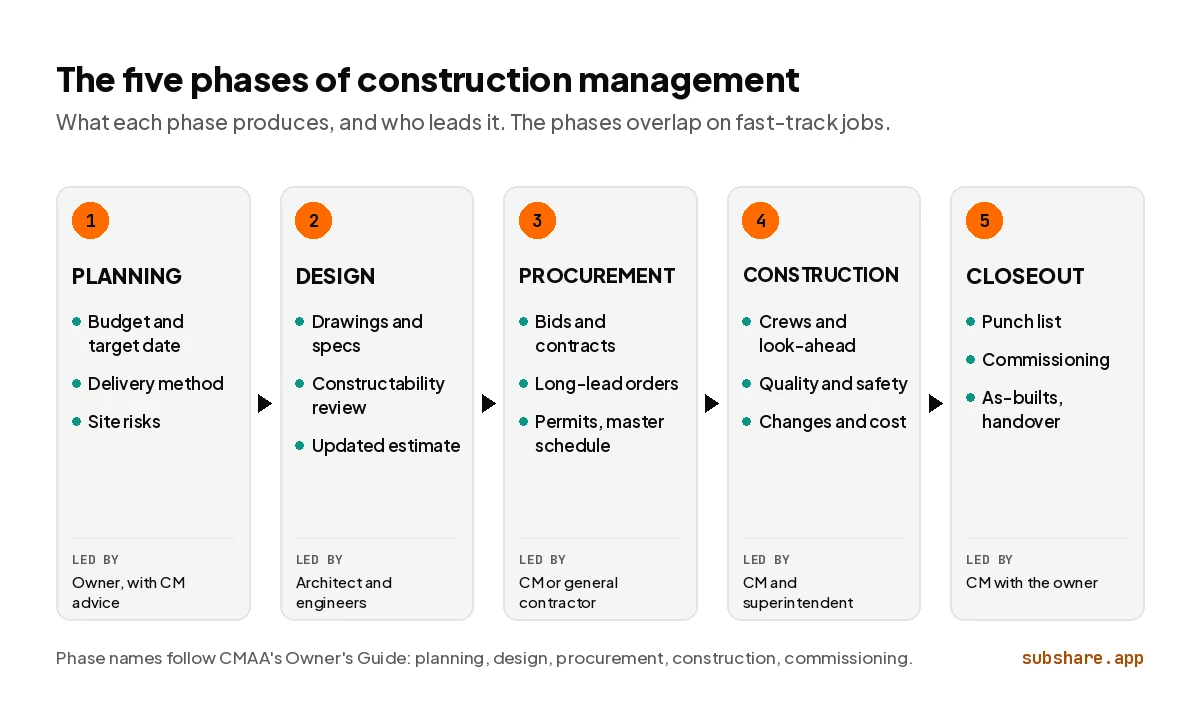
- Planning (pre-design). The owner decides what to build. The CM helps set the budget, target date and delivery method, and flags site risks.
- Design. Architects and engineers draw it. An early CM checks buildability, updates the estimate and flags long-lead items.
- Procurement. Trade packages are bid and bought, long-lead items ordered, permits pulled and the master schedule set.
- Construction. Crews build. The CM runs the schedule, coordinates trades and deliveries, checks quality and safety, handles changes and RFIs, and tracks cost.
- Closeout. Punch lists, commissioning, as-builts, warranties and final payment.
The phases overlap. On fast-track jobs, foundations start while upper floors are still in design, one reason owners bring a CM in early.
What does construction management control?
Construction management controls 6 things, according to CMAA: schedule, cost, quality, safety, scope and function. Each has its own documents, and a question the CM must always be able to answer.
| Area | The question it answers | Typical documents and tools |
|---|---|---|
| Schedule | Will we finish on time, and what happens next week? | Master schedule, look-ahead, weekly work plan, daily crew plan |
| Cost | Are we inside the budget, and what will it cost at the end? | Estimate, budget, cost reports, change orders, pay applications |
| Quality | Is the work built to the drawings and specifications? | Inspection and test plans, punch lists, submittals |
| Safety | Is everyone going home in one piece? | Site safety plan, toolbox talks, incident reports |
| Scope | Are we building what the contract says, and nothing extra unpaid? | Contract documents, RFIs, change log |
| Function | Will the finished building do what the owner needs? | Design reviews, commissioning records, operation manuals |
Source: the 6 areas are from CMAA's definition of construction management. The questions and document lists are our summary.
Schedule is the area everyone sees first. Our construction scheduling guide covers it, from the master schedule down to each crew's day.
Agency CM vs CM at risk: what is the difference?
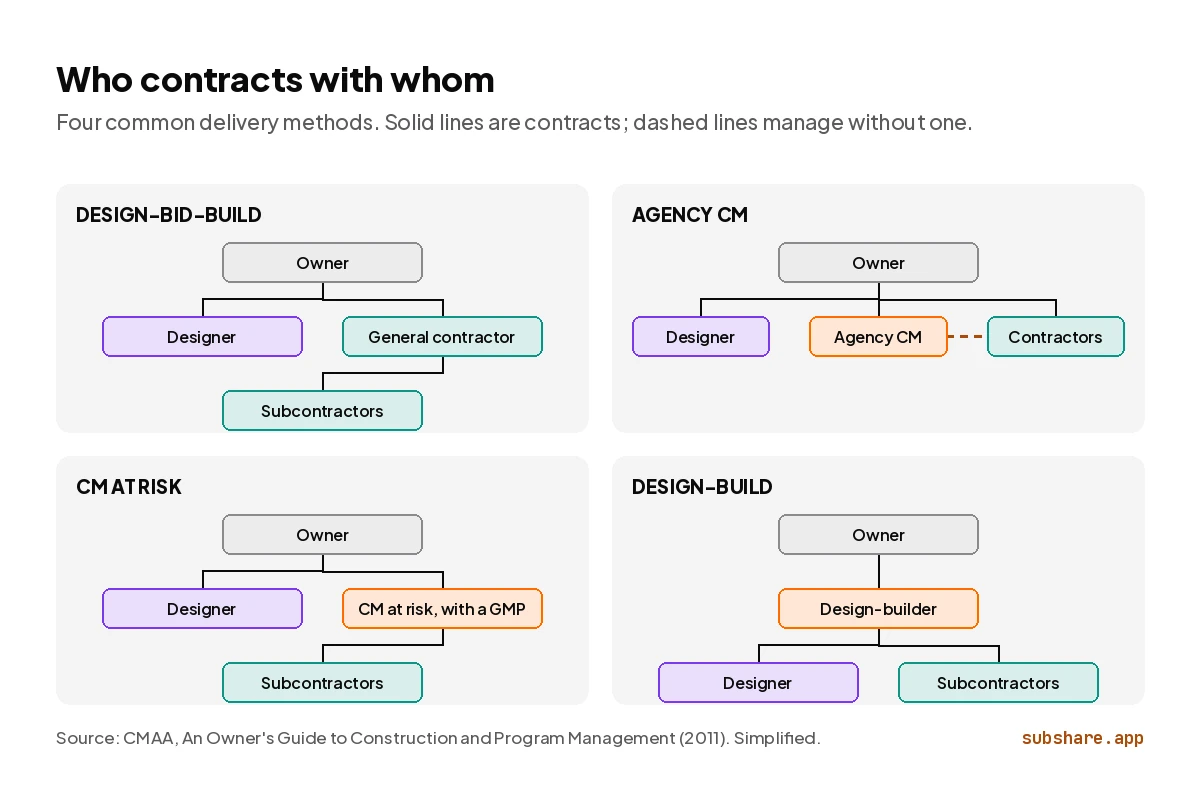
An agency construction manager advises the owner for a fee and holds no contracts with the trades. A construction manager at risk advises during design, then guarantees a maximum price and holds the subcontracts during construction. CMAA's Owner's Guide puts it this way: under CM at risk, “The CM converts to the legal equivalent of a general contractor once a price is agreed for the performance of the construction work.”
| Agency CM | CM at risk | |
|---|---|---|
| Who the CM works for | The owner, as its principal agent | The owner, as adviser and then as builder |
| Contracts with the trades | None; the owner or a general contractor holds them | The CM holds the subcontracts |
| How the CM is paid | A professional fee | A fee plus the cost of the work, up to a guaranteed maximum price |
| Who carries cost overrun risk | The owner | The CM, above the guaranteed maximum price |
| When the CM joins | Any phase, often from planning | Usually during design |
| Also called | CM agency, CM adviser, owner’s representative | CMAR, CM/GC |
Source: CMAA, An Owner's Guide to Construction and Program Management (2011). The 'also called' row lists common US usage.
The choice comes down to who holds the risk. An owner with its own building team often hires an agency CM to watch cost and quality. An owner that wants one firm accountable for price and schedule, with the builder's input during design, picks CM at risk.
How does construction management fit each delivery method?
A project delivery method sets who contracts with whom. The CM's job looks different in each. CMAA calls design-bid-build the traditional US method: the designer finishes the drawings before contractors bid.
| Delivery method | How it works | Where construction management sits |
|---|---|---|
| Design-bid-build | The designer finishes the drawings, contractors bid, and the lowest qualified bid usually wins a fixed price. | With the general contractor during construction, and with an agency CM if the owner hires one. |
| CM at risk | The CM consults during design, then commits to a guaranteed maximum price for the work. | With the CM throughout, as adviser first and builder second. |
| Design-build | One contract covers design and construction. | Inside the design-build firm, often with an agency CM watching for the owner. |
| Multiple prime contracts | The owner signs several trade contractors directly, with no general contractor. | With an agency CM, who coordinates the prime contractors for the owner. |
Sources: CMAA Owner's Guide (design-bid-build, CM at risk and design-build definitions); multiple primes from the same guide's list of alternative methods.
Design-build has grown fastest. FMI research for the Design-Build Institute of America, published in April 2023, expected design-build to represent over 47% of spending in 2026 in the segments it studied, with 22.5% growth from 2022 to 2026. Highway and street, education and manufacturing work hold the largest shares, so 47% is not a figure for all US construction.
Who does what on a construction project?
On a typical commercial job, the owner sets the goals, the designer draws the building, the project manager runs the contract and the money, the superintendent runs the site, and foremen run the crews. Titles vary by company; the split is common.
| Role | Responsible for | Mostly works from |
|---|---|---|
| Owner | Budget, goals, final decisions, paying for the work | Office |
| Architect and engineers | Drawings, specifications, answering design questions | Office, site visits |
| Construction manager or project manager | Contract, budget, schedule, subcontracts, changes, reporting | Office and site |
| Superintendent | Daily site operations, sequencing trades, safety, quality, the look-ahead | Site |
| Foreman | One crew or trade: who does what today, materials, tools, safety | Site |
| Crew members and subcontractors | Doing the work to the drawings, safely | Site |
Our summary of common US practice. Small firms often combine roles, so one person can be owner, project manager and superintendent.
Plans most often break at the handoffs. A decision made in a Tuesday meeting has to reach the foreman and then the person holding the tools, often by phone or group chat. If it does not, the crew shows up ready for the old plan.
What does a construction manager do each week?
According to the Bureau of Labor Statistics, construction managers “plan, coordinate, budget, and supervise construction projects from start to finish.” Its list of typical duties reads like a week on a live job:
- Preparing cost estimates, budgets and work timetables.
- Explaining contracts and technical information to other professionals.
- Working with architects, engineers and other construction specialists.
- Selecting subcontractors and coordinating their work.
- Monitoring projects and reporting progress and budget matters to the firm and clients.
- Responding to delays, emergencies and other project problems.
- Making sure projects meet legal requirements, such as building and safety codes.
The BLS adds that most construction managers work full time, some more than 40 hours a week, and that they may be on call 24 hours a day for project emergencies.
A week on site has a rhythm. Monday starts with what slipped last week. Midweek brings the owner meeting and the subcontractor meeting, where the next 3 weeks are planned. Friday ends with progress, cost, and who goes where on Monday. Our guide to the 3-week look-ahead schedule covers that midweek planning meeting step by step.
How much do construction managers earn, and how do you become one?
The median annual wage for construction managers in the United States was $114,990 in May 2025, according to the Bureau of Labor Statistics. The lowest 10% earned less than $69,690 and the highest 10% more than $189,440. There were 609,100 jobs in 2025, and the BLS projects 9% growth from 2025 to 2035, much faster than average, with about 49,700 openings a year.
| Measure | Figure | Period |
|---|---|---|
| Median annual pay | $114,990 ($55.28 an hour) | May 2025 |
| Lowest 10% earned less than | $69,690 | May 2025 |
| Highest 10% earned more than | $189,440 | May 2025 |
| Number of jobs | 609,100 | 2025 |
| Projected growth | 9%, much faster than average | 2025 to 2035 |
| Openings per year | About 49,700 | Average over the decade |
| Typical entry-level education | Bachelor’s degree | — |
Source: U.S. Bureau of Labor Statistics, Occupational Outlook Handbook, Construction Managers, accessed October 24, 2026.
Pay depends on the kind of work. Managers on commercial buildings and civil projects earn the most, and 38% of all construction managers are self-employed.
| Industry | Share of jobs | Median annual pay |
|---|---|---|
| Self-employed workers | 38% | Not published |
| Specialty trade contractors | 17% | $104,100 |
| Nonresidential building construction | 15% | $126,690 |
| Residential building construction | 9% | $98,390 |
| Heavy and civil engineering construction | 8% | $124,430 |
Source: U.S. Bureau of Labor Statistics, Occupational Outlook Handbook, Construction Managers (Work Environment and Pay tabs). Shares do not add to 100% because smaller industries are not listed.
Most managers start with a bachelor's degree in construction management, construction science, engineering or architecture. The BLS adds that site experience is important, “especially for ones who do not have a bachelor's degree,” and that new managers typically work under an experienced one for up to 1 year.
Plenty of superintendents and project managers came up through the trades instead, moving from apprentice to foreman to superintendent. For a credential, CMAA's Certified Construction Manager (CCM) program, run by the Construction Manager Certification Institute, asks for documented education and field experience, at least 2 references and a passed exam covering 10 practice areas.
Where do construction projects lose time and money?
Most projects lose time to coordination, not to the work itself. McKinsey's June 2016 report Imagining construction's digital future found that large projects “typically take 20 percent longer to finish than scheduled and are up to 80 percent over budget.” Surveys of the people running the work point at the same cause: information that does not reach the people who need it.
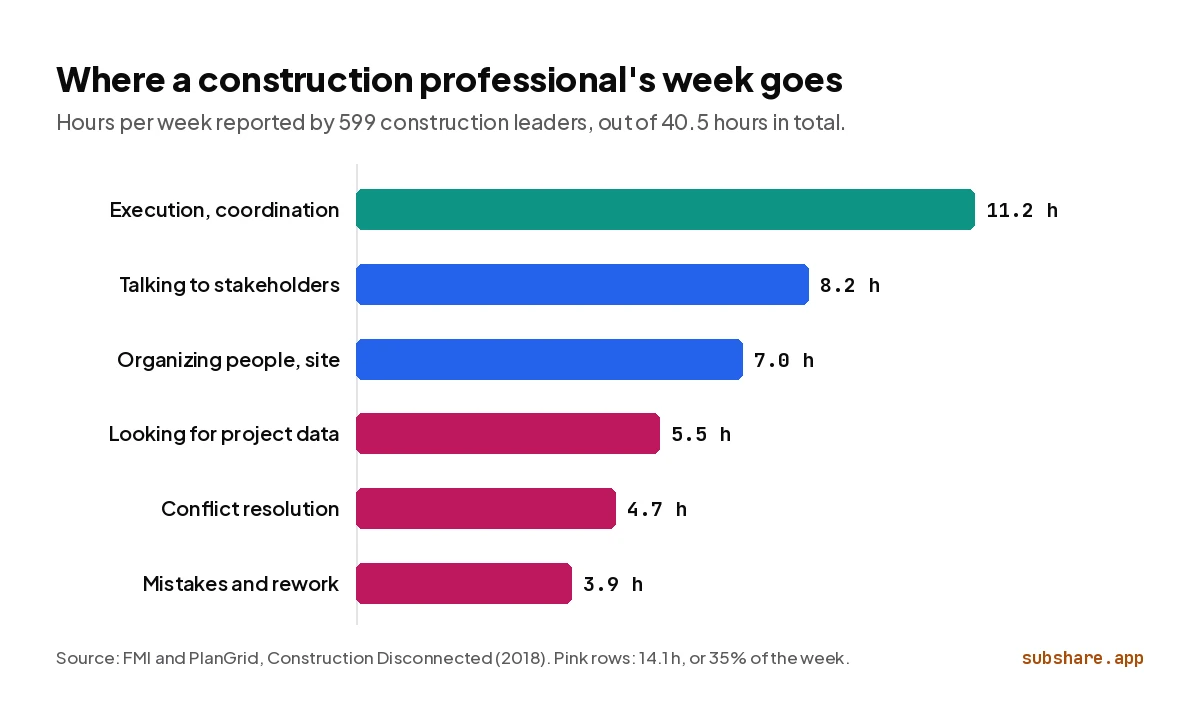
A 2018 survey of 599 construction leaders by FMI and PlanGrid, Construction Disconnected, asked how they spent a 40.5-hour week. They reported 5.5 hours looking for project data, 4.7 hours on conflict resolution and 3.9 hours dealing with mistakes and rework. That is 14.1 hours, or 35% of the week, on what the report calls non-optimal activities.
The same report estimated that 52% of all rework is caused by poor data and miscommunication, and put the 2018 cost of that rework in the United States at $31.3 billion. On the planning side, the Lean Construction Institute says that “only 54% of work planned for a given week is completed within the allotted schedule.” Taken together, the numbers point the same way: the biggest gains usually come from planning the next few weeks well and making sure everyone hears about it.
| Figure | What it measures | Source and date |
|---|---|---|
| $2,157.6 billion | US construction spending, seasonally adjusted annual rate | Census Bureau, July 2026 |
| 609,100 | Construction manager jobs in the United States | BLS, 2025 |
| $114,990 | Median annual pay for construction managers | BLS, May 2025 |
| 9% | Projected job growth, 2025 to 2035 | BLS |
| 14,000+ | Members of the Construction Management Association of America | CMAA, founded 1982 |
| 20% and 80% | Typical schedule overrun and maximum budget overrun on large projects | McKinsey, June 2016 |
| 35% | Share of a 40.5-hour week spent on non-optimal work | FMI and PlanGrid, 2018 |
| 52% | Share of rework caused by poor data and miscommunication | FMI and PlanGrid, 2018 |
| 54% | Share of planned weekly work completed on schedule | Lean Construction Institute |
| 47%+ | Design-build share of 2026 spending in the segments studied | FMI for DBIA, April 2023 |
Each figure is sourced and explained in the sections above; the full source list is at the end of this guide.
What do well-managed construction jobs have in common?
Well-run jobs share 8 habits, and none needs a large budget:
- One current schedule. There is a single master schedule, updated weekly, and everyone knows where it lives.
- A weekly look-ahead. The superintendent and trade foremen plan the next 3 weeks together every week, task by task.
- Constraints logged and owned. Missing drawings, late materials and pending inspections are written down, each with a name and a date.
- A daily plan for every person. Each worker knows the site, the start time and the task before they leave home.
- One place for current drawings. Nobody builds from a superseded sheet.
- Decisions in writing. Changes, RFIs and verbal instructions are recorded the same day.
- A 10-minute daily huddle. At the start of the shift, on today's work and today's hazards.
- Closeout as you go. Punch items and as-built markups are cleared area by area, not in a rush at the end.
Habits 2 to 5 go straight at the lost hours in the FMI survey: the 5.5 hours a week its respondents spent looking for project data, and the rework that follows a crew working from an old plan.
What software do construction managers use?
Most CMs use a stack, not one program: estimating, scheduling, project management, field and accounting tools, with a spreadsheet filling the gaps.
| Category | What it does | Examples |
|---|---|---|
| Scheduling | Builds and updates the master schedule and critical path | Primavera P6, Microsoft Project |
| Project management platforms | Drawings, RFIs, submittals, budgets and changes in one place | Procore, Autodesk Forma Build |
| Field management | Drawings, tasks, punch lists and reports on a phone or tablet | Fieldwire |
| Photo documentation | Time-stamped site photos by project | CompanyCam |
| Crew scheduling | Who works where each day, sent to each person | SubShare |
| Accounting and payroll | Job costing, invoices, payroll | Construction accounting suites |
Examples are illustrative, not a ranking. Prices and features change; check each vendor.
If you are choosing between the big platforms, we have compared prices in Procore alternatives, Fieldwire pricing and Fieldwire vs Procore. For most small and mid-size contractors, the harder problem is not the platform. It is getting each day's plan to the people in the field.
Where does SubShare fit?
Disclosure: SubShare is our product. It covers one slice of construction management: the daily crew plan. It does not do estimating, RFIs, submittals, budgets or the master schedule.
SubShare is a crew scheduling board. A foreman or superintendent puts each job on a person and drags it when the plan changes. Each worker gets one permanent link by text or WhatsApp that opens their week in the phone's browser, with the site address, access details and attached drawings. There is no app to install and no account, and the plan stays readable without signal once it has been opened.
SubShare is free for up to 5 people, then $29 a month for up to 20 and $59 for up to 40. You can try the demo board without signing up.
Construction management: frequently asked questions
Is construction management the same as project management?
Not quite. Project management is the general discipline; construction management applies it to building, where drawings, codes, inspections, weather and subcontractors shape the work. On many jobs the project manager does construction management work.
How much does a construction manager make?
The median was $114,990 a year in May 2025, according to the Bureau of Labor Statistics. The lowest 10% earned under $69,690 and the highest 10% over $189,440.
Do you need a degree to work in construction management?
A bachelor’s degree is the typical entry route, according to the Bureau of Labor Statistics, which also says site experience matters most for managers without one. Many superintendents start as tradespeople or foremen.
What is the job outlook for construction managers?
The Bureau of Labor Statistics projects 9% growth from 2025 to 2035, much faster than average, with about 49,700 openings a year on top of 609,100 jobs in 2025.
What is a CCM certification?
The Certified Construction Manager credential from the Construction Management Association of America, run by the Construction Manager Certification Institute. It requires documented education and experience, 2 references and an exam covering 10 practice areas.
How we wrote this guide
We wrote this guide from published sources on October 24, 2026. Here is what we did:
- Took the definition and the 6 areas of construction management from CMAA, and the phases, the 2 forms of CM and the delivery method definitions from CMAA's Owner's Guide.
- Took pay, pay by industry, jobs, outlook, duties and education from the Bureau of Labor Statistics' Occupational Outlook Handbook page for construction managers, and July 2026 construction spending from the Census Bureau's monthly release.
- Read the FMI and PlanGrid Construction Disconnected report in full and took the weekly hour figures and the rework share from it.
- Took the schedule and budget overrun figure from McKinsey's June 2016 report, and the share of weekly plans completed from the Lean Construction Institute.
- Wrote the role, area and practice summaries ourselves, and labeled them as ours.
No organization quoted here sponsored or reviewed this guide. SubShare is the one product we sell, and its section is labeled. If a figure is out of date, email [email protected] and we will correct it and update the date on this page.
Related guides
Sources, accessed October 24, 2026
- CMAA: What is construction management? (definition, the 6 areas, compatibility with all delivery methods).
- CMAA: An Owner's Guide to Construction and Program Management (2011) (phases, agency CM and CM at risk, delivery methods).
- U.S. Bureau of Labor Statistics: Construction Managers (pay, pay by industry, jobs, outlook, duties, education, self-employment).
- U.S. Census Bureau: Construction Spending (July 2026, released September 1, 2026) and Wikipedia: Construction Management Association of America (founding, membership, CMCI).
- CMAA: Certified Construction Manager (CCM requirements).
- FMI and PlanGrid: Construction Disconnected (2018) (hours per week, 35% non-optimal time, 52% of rework).
- McKinsey: Imagining construction's digital future (June 2016) (schedule and budget overruns on large projects).
- Lean Construction Institute: Last Planner System (54% of weekly planned work completed).
- DBIA: New design-build research shows continued growth, April 14, 2023 (design-build share of spending and growth in the assessed segments).
- SubShare pricing.
About the author
Josh Rohrbach · Owner, Rohrbach Construction
Josh Rohrbach owns Rohrbach Construction in Ohio and has run the company since 2022. Running a construction business day to day is the perspective behind SubShare’s guides on managing and scheduling jobs.
Connect with Josh Rohrbach on LinkedIn →Plan the week once. Everyone knows where to be.
30 days of Team features. No card required. Then continue on Free within its limits, or choose a paid plan.
Start free