Fieldwire vs Procore in 2026: Price, Features and Fit
Fieldwire charges per user; Procore charges by construction volume with unlimited users. What each costs as the team grows, and where each one fits.
Fieldwire vs Procore: the short answer
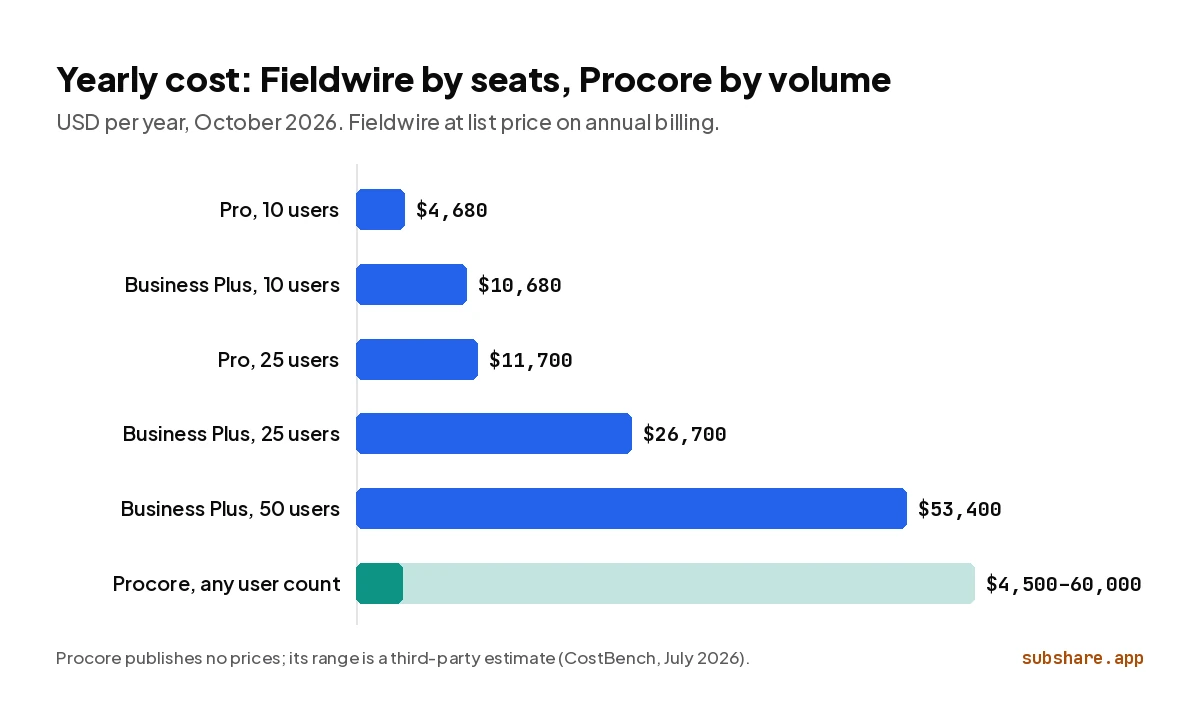
Fieldwire and Procore charge in opposite ways, and that settles most comparisons before features come into it. Fieldwire, owned by Hilti, is a field app priced per user: free for up to 5 users, then $39, $64 or $89 per user per month on annual billing. Procore is a full construction management platform that charges an upfront annual fee per product, set by your annual construction volume, with unlimited users. Procore publishes no prices; third-party trackers put contracts at roughly $4,500 to $60,000 a year. Fieldwire usually costs less for a field team of up to a few dozen people who need drawings, tasks and punch lists. Procore starts to make sense when many companies must log in to the same project, or when RFIs, submittals and financials have to live in one system. As a yardstick, a $20,000 Procore quote buys 18 Fieldwire Business Plus seats for a year.
Teams tend to reach this comparison from one of two directions. Either a superintendent has been running Fieldwire on a few jobs, the user count has crept up, and someone in the office asks whether it is time for a bigger platform. Or the company already has a Procore quote, winced at it, and wants to know whether Fieldwire would cover what the field actually uses.
Both are fair questions, and the answer depends less on features than on a head count: how many people need to log in, and how many of them work for you. This guide compares Fieldwire and Procore on what each costs as that number grows, what each does with drawings, tasks, RFIs and money, and what happens when you invite subcontractors. Every Fieldwire price was checked on October 5, 2026.
Fieldwire vs Procore at a glance
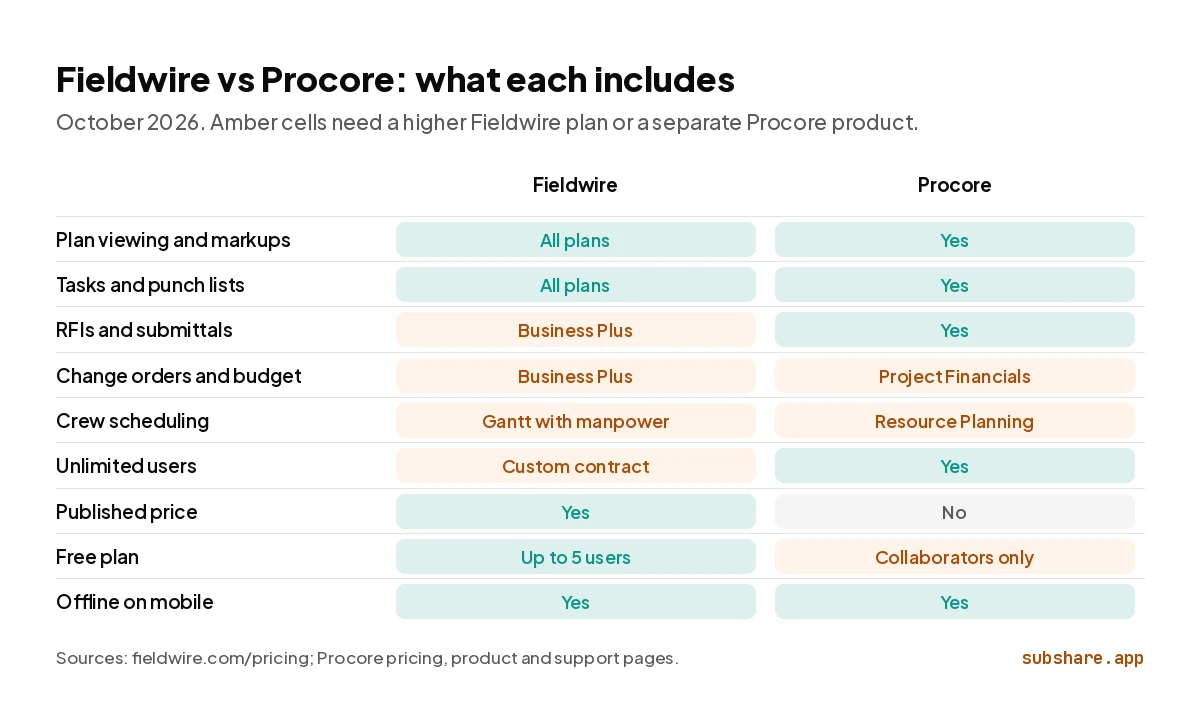
Fieldwire is a field management app for superintendents, foremen and crews. Procore is a construction management platform for the whole project team, sold as separate products for project management, quality and safety, financials, preconstruction and resource management. The table compares them on the points that decide most purchases.
| Compared on | Fieldwire | Procore |
|---|---|---|
| Owner | Hilti (since November 2021) | Procore Technologies (NYSE: PCOR) |
| Built for | Superintendents, foremen and field crews | The whole project team: office, field and finance |
| Pricing model | Per user, per month | Upfront annual fee per product, by annual construction volume |
| Published price | Yes: $39, $64 or $89 per user/month on annual billing | No, quote only |
| Users | Each one is a paid licence; unlimited by custom contract | Unlimited at no extra cost |
| Free option | Basic plan: 5 users, 3 projects, 100 sheets | Free company account for joining others' projects and bids (US and Canada) |
| Drawings and markups | Every plan | Yes |
| Tasks and punch lists | Every plan | Yes |
| RFIs, submittals, change orders | Business Plus plan ($89) only | Yes |
| Financials | Budget on Business Plus | Project Financials, sold as its own product |
| Crew scheduling | Gantt view with manpower totals | Resource Planning, sold as its own product |
| Offline on mobile | Yes | Yes |
| Commitment | Monthly or annual; no long-term contract | Annual, paid upfront |
Sources: fieldwire.com/pricing and Fieldwire's help center; Procore's pricing, Drawings, Resource Planning and support pages. Checked October 5, 2026.
How much do Fieldwire and Procore cost in 2026?
Fieldwire costs $39, $64 or $89 per user per month on annual billing in 2026. Procore charges an upfront annual fee set by your construction volume and publishes no price.
Fieldwire's Basic plan is free for up to 5 users, 3 projects and 100 sheets. Its paid plans, Pro, Business and Business Plus, work out to $468, $768 and $1,068 per user per year, and paying month to month costs $15 more on each tier: $54, $79 and $104. Only Business Plus includes RFIs, submittals, change orders and budget, so it is the tier to compare with Procore. Our Fieldwire pricing report works through team sizes and overage charges in detail.
Procore's pricing page says: “We charge an upfront annual fee by product and based upon your Annual Construction Volume,” and “We'll never charge you for adding more users to Procore.” Every contract includes unlimited users and unlimited storage.
With no price list, the only numbers come from third parties. CostBench, a software price tracker, puts Procore contracts at $4,500 to $60,000 a year and reports contractors paying about $700 to $1,000 per $1 million of annual volume. Projul's 2026 review of contractor reports runs higher: $10,000 to $80,000 a year for contractors under $50 million in revenue, with first quotes often around $20,000 to $30,000. Treat these as rough guides and get your own quote. We look at the fee more closely in what Procore costs in 2026.
For a 10-person team, Fieldwire costs $4,680 a year on Pro and $10,680 on Business Plus. At 25 people it costs $11,700 and $26,700. A Procore fee would not move between those two team sizes, because it follows the value of the work you build and not the number of logins.
At what team size does Procore cost less than Fieldwire?
Procore costs less than Fieldwire once you need more Fieldwire seats than your Procore quote would buy. To find that number, divide the Procore quote by what one Fieldwire seat costs for a year: $468 on Pro, $768 on Business or $1,068 on Business Plus. Below the result, Fieldwire is cheaper on licence cost alone. Above it, Procore is. The table does the division for four quote sizes.
| Procore quote per year | Fieldwire Pro seats ($468) | Fieldwire Business seats ($768) | Fieldwire Business Plus seats ($1,068) |
|---|---|---|---|
| $10,000 | 21 | 13 | 9 |
| $20,000 | 42 | 26 | 18 |
| $30,000 | 64 | 39 | 28 |
| $60,000 | 128 | 78 | 56 |
Whole seats that cost no more than the quote, at Fieldwire's annual-billing list prices on October 5, 2026. Fieldwire offers custom pricing from 50 licences, so list prices stop being the right comparison above that.
Two things bend this arithmetic. First, the like-for-like tier is Business Plus, because it is the only Fieldwire plan with RFIs, submittals and change orders. Second, count everyone who needs a login, not only your own staff. A general contractor with 12 people of its own and 15 foremen from six trades needs 27 Fieldwire licences, unless the trades pay for their own. On Business Plus that is $28,836 a year, more than many of the small-contractor Procore figures above.
Which is better for drawings, tasks and punch lists?
Short answer: Fieldwire for the people working from the sheet; Procore when the sheet has to link to the rest of the project record.
Fieldwire began as a task manager for the jobsite, and it still shows. Plan viewing and task management are on every plan, the free one included. A task or punch item sits on the sheet at the spot it refers to, with its photos, checklist and files attached. Pro adds sheet compare, reports and exports, and custom task statuses. Tasks can be viewed as a Gantt chart, a calendar or a Kanban board, and the app works offline.
Procore's Drawings tool covers the same ground with more automation around it. It splits and names uploaded sets using OCR, keeps revisions under version control and works offline. Markups can link to RFIs, punch list items and submittals, so a question raised on a sheet is tied to the formal record that answers it.
On drawings alone there is little between them. The difference is what surrounds the drawing. In Fieldwire it is the task list. In Procore it is the contract record. If Autodesk is on your shortlist too, see Fieldwire vs PlanGrid (Forma Build) and PlanGrid vs Procore.
Which is better for RFIs, submittals and financials?
Procore is better for RFIs, submittals and financials. They are core Procore tools, and Procore sells Project Financials and Invoice Management as products of their own beside Project Management. Fieldwire offers RFIs, submittal management, change orders and budget only on Business Plus, its $89 tier, and that tier also has a one-way QuickBooks Online integration that pulls expenses in as actual costs.
A practical test: if your contracts require a formal RFI and submittal log, and the owner's representative expects to work in it, Procore is the safer choice. If RFIs are occasional and your accountant lives in QuickBooks, Fieldwire Business Plus covers it for $1,068 per user per year.
What happens when you invite subcontractors?
Invite a subcontractor to Fieldwire and you pay for another licence. Invite one to Procore and the fee does not change. This is where the two pricing models feel most different on a live job.
Fieldwire counts everyone. Its help center says adding subcontractors “will increase your user count, regardless if they are invited as a follower, a member or an admin.” The exception is a subcontractor who already pays for their own Fieldwire plan; then you are not charged. You are charged once per unique person, so a foreman on five of your projects is one licence.
If you are on annual billing and invite more people than you hold licences for, Fieldwire bills the extras at the monthly rate, $54, $79 or $104 depending on tier, until you buy more licences or remove them. Our pricing report explains how Fieldwire bills users added mid-contract.
Procore counts no one. Subcontractors, owners and designers can be invited without adding to the fee, and Procore says more than 3 million people use it under that model. Companies that only need to join other firms' projects can do so with a free Procore company account, which Procore currently offers in the United States and Canada.
Free seats do not make the rollout free. With either product, each subcontractor still creates a login, installs the app and learns where things are. On a job where trades rotate every few weeks, that is often the harder part.
Which one tells the crew where to be?
Neither Fieldwire nor Procore is built around that question. Fieldwire schedules tasks: its Gantt view lays work out across dates and totals the manpower each stretch needs. Procore schedules people through Resource Planning, formerly LaborChart, which it sells as its own product. Resource Planning forecasts labor across projects and can send assignments by automated email, text or in-app notification.
Hilti has a tool of its own here too. A Fieldwire help article from September 2026 describes a one-way project sync from Fieldwire to Hilti CrewCenter for resource management.
All three are planning tools for the office. For the worker, the daily question is smaller: which site, what time, which drawing. Check how each product answers it for someone who has no login yet. We set Resource Planning beside a lighter approach in Procore alternatives.
Which is easier to roll out, and what do users say?
Fieldwire is easier to start. You can sign up online, run the free plan on one job and move to a paid plan with no long-term contract. Procore is bought through its sales team on an annual fee paid upfront, and its breadth means setup is a project with an owner.
Review scores are close. On Software Advice, as read on October 5, 2026, Fieldwire scores 4.6 out of 5 from 99 reviews and Procore 4.5 from 2,677. Fieldwire leads slightly on ease of use (4.5 against 4.4) and customer support (4.6 against 4.5), and more clearly on value for money (4.4 against 4.1).
Procore's sample is 27 times larger, so read the small gaps with care. Fieldwire's own comparison page cites G2 scores of 8.7 against 8.2 for ease of setup; that is a vendor quoting figures in its own favor.
Can you use Fieldwire and Procore together?
You can run Fieldwire and Procore side by side, but neither vendor lists a native connector between them. Some contractors keep Procore in the office for the contract record and Fieldwire in the field for tasks and punch lists.
On October 5, 2026 we searched Procore's App Marketplace, which listed more than 400 apps, and found no Fieldwire app. Fieldwire's help center documents integrations with Google Drive, SharePoint, Microsoft Teams, Power BI, Docusign and QuickBooks Online on its Business and Business Plus plans, and none with Procore.
Several comparison articles describe a real-time sync between the two. We could not find one on either vendor's own pages. If running both matters to you, ask each vendor in writing how drawings and RFIs would move between them, and budget for someone to keep the two in step.
Fieldwire or Procore: which one should you choose?
Choose Fieldwire if your main users are in the field and fewer than about 20 people need a login. Choose Procore if many companies must work in the same project, or if RFIs, submittals and financials are contract requirements on most of your jobs. The checklists spell that out.
Choose Fieldwire if
- The main users are superintendents and foremen, and the office mostly needs reports.
- Fewer than about 20 people need a login, and most of them work for you.
- You want to start this week on a published price, with a free plan to trial.
- RFIs and submittals are occasional, or Business Plus covers them.
Choose Procore if
- Subcontractors, owners and designers all need to work in the same project.
- RFIs, submittals, change orders and budgets are contract requirements on most jobs.
- You want field, office and financials on one platform, and can staff the rollout.
- Your annual construction volume makes a volume-based fee predictable.
Still unsure?
- Count every person who needs a login, yours and other companies', for a typical job.
- Price that count on Fieldwire Business Plus: users × $1,068 a year.
- Ask Procore for a quote on Project Management alone, then with the products you would add.
- Run Fieldwire's free plan on one job while you wait for the quote.
Where does SubShare fit?
Disclosure: SubShare is our product. Fieldwire and Procore both reach the crew through an app and a login. On Fieldwire each of those logins is a paid licence. On Procore they are free, but each one still has to be set up. SubShare handles one job, telling each person where they are working this week, and asks nothing of the worker to see it.
SubShare is a crew scheduling board. A foreman or supervisor puts each job on a person and drags it when plans change. Each worker gets one permanent link by text or WhatsApp. It opens their week in the phone's browser with the site address, the access code and the attached drawings. There is no app and no account, and the plan keeps working without signal once it has been opened.
SubShare is free for up to 10 people, $29 a month for up to 20 and $59 for up to 40, so a 20-person crew costs less than one Fieldwire Pro seat. It has no punch lists, markups, RFIs or submittals, so it runs beside Fieldwire or Procore and does not replace them. You can try the demo board without signing up.
Fieldwire vs Procore: frequently asked questions
Is Fieldwire cheaper than Procore?
For a small field team, usually. Ten users cost $4,680 a year on Fieldwire Pro and $10,680 on Business Plus. Procore publishes no prices; third-party trackers put contracts at roughly $4,500 to $60,000 a year. Fieldwire's bill grows with every user and Procore's does not, so the gap closes as you add people.
Does Procore charge per user?
No. Procore charges an upfront annual fee per product, based on your annual construction volume. Its pricing page says it will never charge for adding more users, and contracts include unlimited users and unlimited storage.
Does Fieldwire charge for subcontractors?
Yes. Fieldwire's help center says adding subcontractors increases your user count whether they join as a follower, a member or an admin. You are not charged for a subcontractor who already pays for their own Fieldwire plan.
Is Fieldwire owned by Procore?
No. Fieldwire is owned by Hilti, which agreed to buy it in November 2021, and is sold as Fieldwire by Hilti. Procore Technologies is a separate public company listed on the New York Stock Exchange as PCOR.
Does Fieldwire integrate with Procore?
Not natively, as far as either vendor's own pages show. On October 5, 2026 Procore's App Marketplace listed no Fieldwire app, and Fieldwire's help center documented integrations with tools such as SharePoint, Google Drive, Power BI and QuickBooks Online, but none with Procore. Ask both vendors before planning to run the two together.
Is there a free version of Fieldwire or Procore?
Fieldwire's Basic plan is free for up to 5 users, 3 projects and 100 sheets. Procore offers a free company account, currently in the United States and Canada, for joining other companies' Procore projects and responding to bids. It does not include Procore's paid project management products.
Which is better for a small contractor, Fieldwire or Procore?
Fieldwire, in most cases. It has a free plan, published per-user prices from $39 a month and no long-term contract, and it covers drawings, tasks and punch lists. Procore suits a small contractor mainly when contracts demand formal RFIs, submittals and financial tracking with many outside companies logging in.
Can Fieldwire replace Procore?
For the field side, yes: drawings, markups, tasks, punch lists, forms and a Gantt schedule. Fieldwire's Business Plus plan adds RFIs, submittals, change orders and budget. It does not match Procore's separate products for project financials, invoicing, bid management and resource planning.
Which is better for scheduling a crew?
Neither is built mainly for it. Fieldwire's Gantt view shows tasks across dates with manpower totals. Procore sells Resource Planning as its own product, which forecasts labor and can send schedules by email or text. For a simple who-goes-where plan with no worker login, a crew scheduling board such as SubShare is lighter.
How we compared
We compared the two products from what each vendor publishes, on October 5, 2026. Here is what we did:
- Read Fieldwire's pricing page and help center, and worked out every Fieldwire figure in this article from its list prices.
- Read Procore's pricing, Drawings, Resource Planning and support pages, and quoted its pricing policy word for word.
- Took Procore's cost range from two third-party sources, CostBench and Projul, because Procore publishes no prices. Those figures are marked as estimates wherever they appear.
- Searched Procore's App Marketplace and Fieldwire's help center for a connector between the two products.
What we did not do: we did not use paid accounts for either product or request a Procore quote, and the review scores are Software Advice's, not ours. Neither company paid for or reviewed this article. SubShare is the one product we sell, and its section is labeled.
Prices change. If a figure here is out of date, email [email protected] and we will correct it and update the date on this page.
Related comparisons
Sources, accessed October 5, 2026
- Fieldwire pricing, Fieldwire help: Pricing and Overages and Should I add my subcontractors to my projects?
- Fieldwire help: the Gantt view, setting up integrations, QuickBooks Online and Hilti CrewCenter.
- Fieldwire: Hilti acquisition announcement and Fieldwire's own Fieldwire vs Procore comparison (updated January 13, 2026).
- Procore pricing (quotes on annual construction volume, unlimited users and user count), Procore Drawings and Procore Resource Planning.
- Procore support: Free Procore Company Account and Procore App Marketplace.
- Procore cost estimates: CostBench (last verified July 8, 2026) and Projul.
- Software Advice: Fieldwire vs Procore ratings and Wikipedia: Procore.
- SubShare pricing.
About the author
James M. · Owner/Project Manager, JJB General Contractors
James M. is the owner and project manager at JJB General Contractors, where he runs jobs and coordinates subcontractors on site every day. That hands-on field perspective shapes what SubShare writes about planning crews and getting each person their week.
Connect with James M. on LinkedIn →Plan the week once. Everyone knows where to be.
14 days of Team features. No card required. Then continue on Free within its limits, or choose a paid plan.
Start free